


Walk into any high-end tech incubator or elite networking event, and eventually, you will hear the exact same pitch. An ambitious founder wants to build a “closed, highly exclusive digital space for high-net-worth individuals.”
On paper, it sounds flawless. Wealthy individuals value privacy, peer-to-peer networking, and frictionless access to luxury assets.
But when you view this concept through the analytical, uncompromising lens of the Sigma mindset, the fatal flaw reveals itself instantly. The wealthy do not want to socialize on an app simply because they are wealthy.
Historically, this specific model is a graveyard of good intentions. Platforms like Netropolitan, ASmallWorld (in its early days), and BeautifulPeople tried to build digital VIP rooms, but struggled with long-term retention and scale. Why? Because they misunderstood the deep psychology of the luxury consumer.
If you want to build a digital ecosystem for the elite, you have to stop thinking like a tech startup and start thinking like a private wealth management office.
This is the strategic reality check on why standard social media mechanics clash with the luxury mindset, and how you must completely rewrite the business playbook to make a private network viable.
1. Strategic Reality Check
Luxury is built on scarcity, prestige, and a deeply understood paradox: extreme wealth seeks strategic solitude, not digital noise.
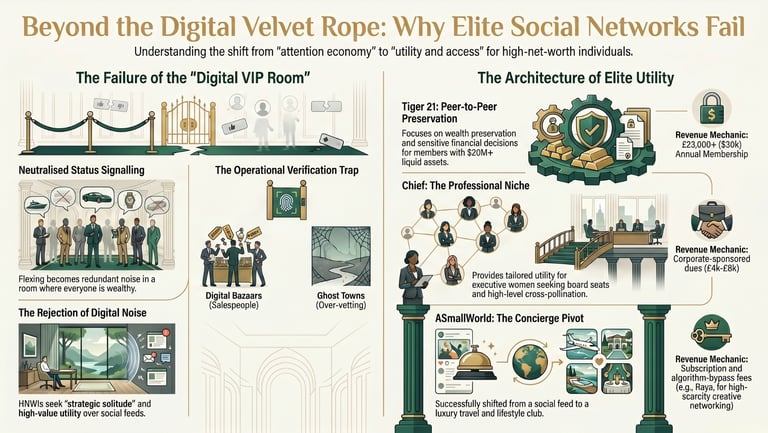
Paradox of “Status Signaling”
Mainstream social media thrives on the attention economy. It is built entirely on conspicuous consumption, people posting luxury to signal status to a wider, aspirational audience.
But when you build an ultra exclusive app where everyone is wealthy, the standard mechanism of status signaling is completely neutralized. Flexing a hypercar in a room full of hypercar owners is not a flex; it is redundant noise.
Sigma consumer rejects this entirely. To be attractive, the platform cannot be about “showing off.” It must pivot entirely toward utility, friction-free asset acquisition, or vetted peer-to-peer collaboration (e.g., sourcing an off-market superyacht, finding co-investors for commercial real estate, or discreet talent acquisition).
Verification Nightmare vs. Ghost Town
To maintain the velvet rope, you need strict verification, bank statements, asset checks, hefty annual fees. But here lies the operational trap.
If your verification is too relaxed, the platform loses its luxury status immediately and fills with salespeople trying to pitch the wealthy. It becomes a digital bazaar.
If it is too strict, your user base remains tiny, leading to low engagement, the dreaded “ghost town” effect.
2. Case Studies in Survival
Transforming a standard platform concept into a luxury ecosystem requires an invisible shift in how value is delivered. You must abandon the “attention economy” (where users are the product sold to advertisers) and adopt a “utility and access” economy.
For a user base that inherently values calmness, strategic solitude, and independence in decision-making, a platform must be entirely devoid of algorithmic noise.
How successful private networks execute this?
Tiger 21: Peer-to-Peer Utility Model
Concept: A highly exclusive peer network for individuals with a minimum of $20M in liquid assets. It is entirely focused on wealth preservation, investment strategies, and philanthropy.
Sigma Appeal: It provides a safe, completely private environment to discuss sensitive financial decisions with vetted peers who face the exact same unique challenges. It is the digital embodiment of strategic solitude.
Economics: Members pay upward of $30,000 annually. When the platform’s core utility helps a user make a $5 million investment decision or avoid a massive tax penalty, the fee is viewed as a negligible operational expense.
ASmallWorld: The “Concierge” Pivot
Concept: Originally launched as the “MySpace for millionaires,” it initially struggled because wealthy users eventually grew bored of simply looking at other wealthy users. They pivoted brilliantly from a purely social feed to a luxury travel and lifestyle club.
Sigma Appeal: They shifted the focus from digital status to real world friction reduction. The platform acts as a digital key to VIP event access, hotel upgrades, and private entry globally.
Economics: They monetize via tiered subscriptions and invisible B2B partnerships, earning commissions on bookings made through their ecosystem while the user gets a complimentary upgrade.
Raya: The Scarcity and Curation Engine
Concept: A private networking app for the creative elite, built entirely on its rejection rate (historically hovering around 92%).
Sigma Appeal: The interface is minimalist, screenshots are strictly prohibited (resulting in immediate bans), and the focus is heavily on privacy and visual storytelling.
Economics: High-volume subscription on a strictly vetted base, combined with micro-transactions to bypass algorithms and directly message highly targeted individuals.
Chief: The Professional Niche
Concept: A private network designed specifically for executive women to cross pollinate ideas and seek board seats.
Sigma Appeal: It identified a highly specific, underserved demographic within the broader affluent market and built tailored, unbothered utility around it.
Economics: They designed the value proposition so effectively that corporations often pay the $5,000 to $10,000 annual dues as a professional development expense, bypassing the user’s personal wallet entirely.
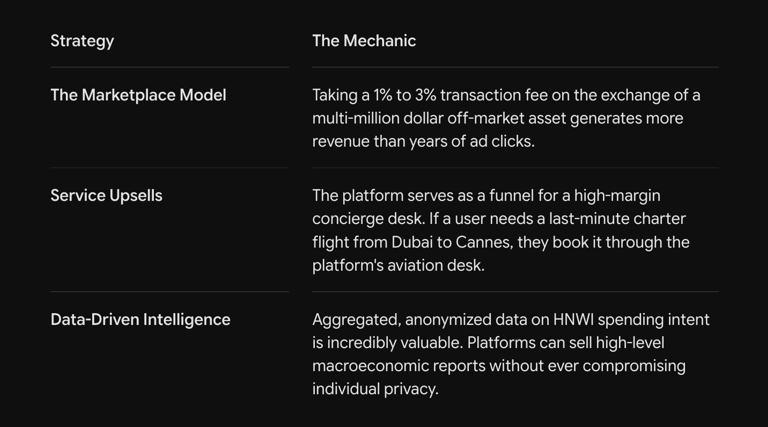
3. The “No-Ad” Monetization Playbook
High-volume, ad-based models do not work here. You are dealing with a low-volume, exceptionally high-value ecosystem. Your revenue model must align seamlessly with high-end consumer psychology.
4. The Execution Masterclass
If you choose to pursue this, you cannot build it like a tech startup; you must build it like an elite concierge service. Do not write a single line of code yet.
Define Your Non-Monetary Angle: Wealth is an entry requirement, not an identity. Determine what unites these individuals beyond their net worth. A platform for rich people is too vague. A platform for “UHNW fine art collectors to securely trade off-market pieces” is a highly viable niche.
Validate the Appetite Manually: Before building an app, see if you can provide the value manually. Create an invite-only WhatsApp group, a highly private newsletter, or host an exclusive private dinner. If you cannot get 20 target users to engage with you manually, an app will not solve that problem.
Architect the Trust Framework: Decide how you will vet members. You must design a system that keeps aggressive service providers out, while ensuring the onboarding process feels like a white-glove luxury experience rather than an IRS audit.
Develop a High-Utility Digital Asset: When you finally build, do not mimic Instagram or LinkedIn. Focus on an immaculate, minimalist interface that prioritizes data privacy, end-to-end encryption, and high-value utility.
The Standard
The Golden Rule of Luxury Tech is absolute: The wealthy value two things above all else, their time and their privacy.
If your platform protects their privacy while saving them time or granting them unique, frictionless access, you have a highly lucrative business. If it requires them to spend their time managing yet another social feed, it will fail.
Luxury
Expertise in luxury marketing and brand transformation.
Strategy
© 2025. All rights reserved.