Tiffany Started With Four Dollars And Ninety Eight Cents And Became An Empire
Five Calculated Masterstrokes That Built The King Of Diamonds
Ayssar Al Shihabi
6/30/20264 min read


In 1837, Charles Lewis Tiffany opened a small stationery and fancy goods emporium in New York City with a $1,000 advance. For the first three days, the store brought in exactly $4.98.
Most merchants would have panicked. They would have discounted their goods, chased the crowd, and compromised their vision just to survive the week.
But Charles Tiffany possessed a distinctly different psychological framework. He did not build a business to react to the market; he built an empire to dictate it. Over the next century, Tiffany & Co. transformed from a struggling stationery shop into the undisputed “King of Diamonds.”
When the masses look at the iconic little blue box, they see a romantic fairytale. But when you analyze this history through the unburdened, highly strategic lens of the Sigma mindset, you see something much more profound. You see a masterclass in psychological leverage, boundary setting, and narrative architecture.
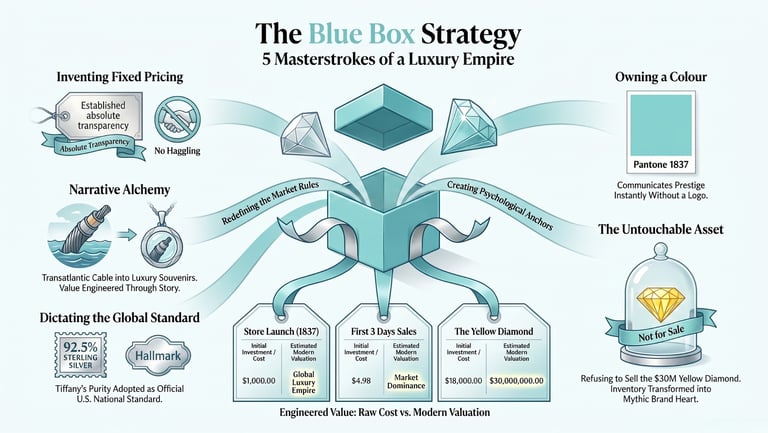
The five calculated masterstrokes that engineered one of the most powerful luxury empires on earth:
1. Inventing Fixed Pricing
In the 1800s, retail was a chaotic bazaar. Haggling and bargaining were the global standard. A merchant would name a high price, the customer would counter, and a tedious, friction-filled dance would ensue.
Haggling is inherently a game of insecurity, it is a merchant admitting that their initial valuation was a lie. Charles Tiffany completely rejected this. He introduced fixed pricing. The price on the tag was the absolute, non-negotiable cost.
To the Sigma mind, this is the ultimate establishment of a boundary. It signaled absolute transparency and unshakeable confidence. It told the client: “We know the exact intrinsic value of our craftsmanship. We will not compromise our standard, and we respect your time too much to play games.” That single move elevated Tiffany from a shopkeeper to an authority.
2. Turning Utility into Artifacts
In 1858, the first transatlantic telegraph cable was laid, connecting North America to Europe. It was an industrial marvel, but essentially, it was just thousands of miles of wire.
When the project concluded, Tiffany bought the leftover cable. He didn’t melt it down; he chopped it up and transformed it into luxury souvenirs, paperweights, umbrella handles, and desk ornaments. The demand was so violent that the NYPD had to be deployed to control the crowds outside his store.
This is the alchemy of luxury. Tiffany understood that wealthy consumers do not buy raw materials; they buy the narrative. By transforming a piece of industrial utility into a tangible piece of history, he proved that true value is engineered through story, not just through gold.
3. Dictating the Absolute Standard
Most brands spend their existence trying to meet the standards set by their competitors. The truly elite simply invent the standard and force the rest of the world to comply.
In the mid-19th century, American silver was wildly inconsistent. Tiffany & Co. bypassed the local market entirely and instituted the English standard of 92.5% purity for all their sterling silver. Eventually, the United States government adopted this exact ratio as the official national standard. Tiffany didn’t just participate in the silver market; they became the unquestioned architect of it.
4. Owning a Color
In 1845, nearly a century before the modern logistics of FedEx or UPS, Tiffany launched the world’s first direct mail jewelry catalog. But the true genius was not the mail-order system itself; it was the cover.
It was printed in a highly specific shade of robin’s egg blue. That color, now trademarked and standardized by Pantone as “1837 Blue”, became a psychological anchor.
To this day, you do not even need to see a logo to know what is inside that box. That is the pinnacle of the Sigma brand strategy: communicating absolute prestige without having to utter a single word.
5. Curating Independent Mastery
A brand that relies solely on its past will eventually suffocate. Tiffany maintained its dominance by continuously elevating fiercely independent creators.
They partnered with designers who possessed their own uncompromising identities, like Elsa Peretti, who turned utilitarian concepts into the legendary bone cuff, and Paloma Picasso, who drew inspiration from the gritty, raw graffiti of New York City and elevated it to high jewelry. Tiffany provided the platform, but they allowed the genius of the individual to shine, proving that true power is not threatened by the brilliance of others; it absorbs it.
The Yellow Diamond
The entire Tiffany philosophy culminates in the story of one specific stone.
In 1877, a massive 128-carat yellow diamond was discovered in South Africa. Charles Tiffany purchased it for roughly $18,000. Today, it carries an estimated valuation of $30 million.
But the true genius of the Tiffany Yellow Diamond is not its price tag. It is the fact that it has never been for sale.
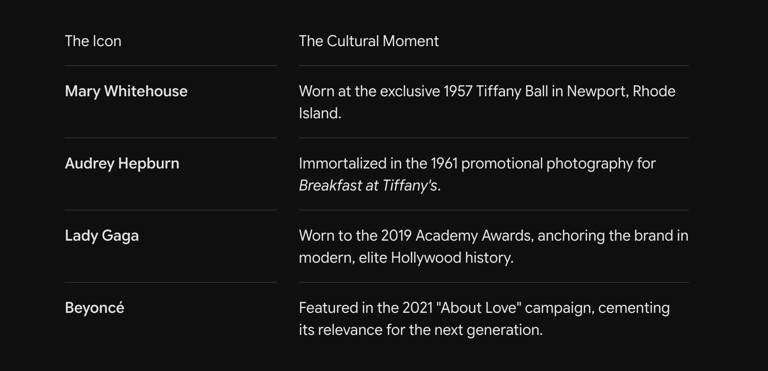
In a market obsessed with transactions, Tiffany made their most valuable asset untouchable. Over its entire history, the brand has only allowed four women to wear it, each carefully selected to cement the diamond’s mythological status:
By refusing to sell the diamond, Tiffany transformed it from a piece of inventory into the beating heart of their brand identity.
The lesson is absolute: Any brand can sell a product for a high price. But it takes true mastery to understand that your most powerful asset is often the one you absolutely refuse to part with.