
The Subconscious Signals That Luxury Houses Target Instead Of Your Eyes
We are often told that luxury is a price tag, a rare material, or a heritage logo. But before the rational mind can articulate any of these concepts, luxury is first and foremost felt. It is sensed, absorbed, and interpreted by the body long before the brain calculates its financial value.
Directing marketing & business strategies here in Dubai, a city that undeniably masters the art of the visual spectacle, I constantly observe a fascinating dichotomy. The loudest brands fight desperately for the eyes of the crowd. But the most enduring luxury houses? They target the subconscious.
For those who operate outside the need for external validation, this distinction is everything. The Sigma mindset doesn’t chase the logo to prove a point to the room; it seeks the uncompromising quality that speaks directly to the individual. Decoding this sensory engineering is at the very heart of the Luxury Code.
A luxury object does not become luxurious simply because of its craftsmanship. It becomes luxurious because it activates a carefully designed, deliberate psychological response. It is not just produced; it is manufactured in perception.
How brands engineer that feeling before you even realize it’s happening?
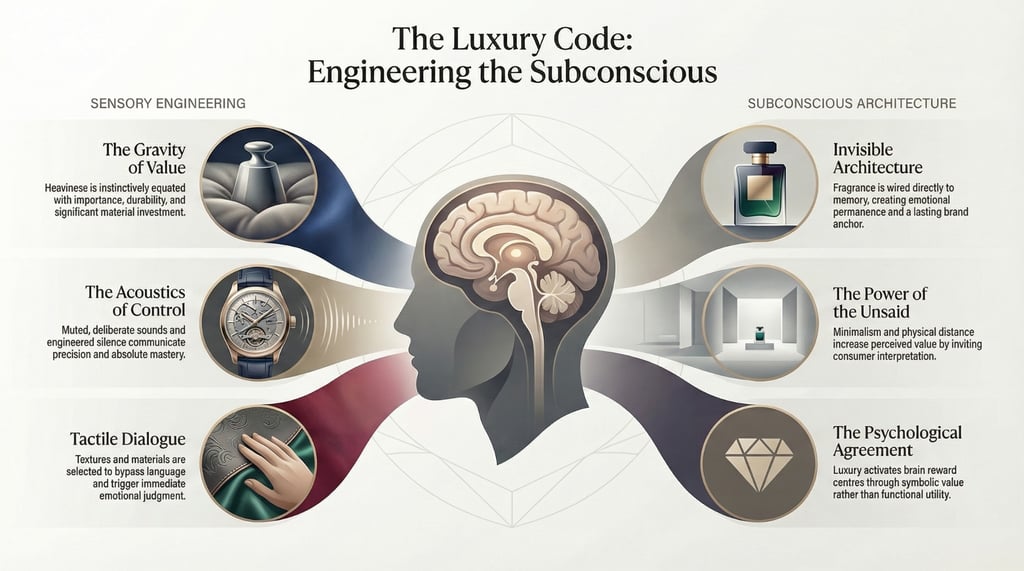
1. The Gravity of Value
One of the most powerful, yet unspoken, signals of luxury is weight. Pick up a heavy fountain pen, and it feels deliberate. Fasten a solid timepiece to your wrist, and its presence feels anchored, real.
Psychologically, our brains instinctively equate heaviness with importance, durability, and material investment. Extra grams are often added to luxury goods not for functionality, but purely for perception. The weight creates gravitas, and that gravitas reassures the buyer that nothing was optimized or compromised. It is a physical manifestation of seriousness.
2. The Tactile Dialogue
Luxury is tactile long before it is visual. The smooth resistance of fine leather, the cold, unapologetic density of metal, the soft friction of a matte finish, these sensations bypass language and go straight to judgment.
Materials are selected not just to endure, but to respond to the hand. Leather that warms slowly. Edges that are perfectly softened. This is where the emotional attachment begins. The object becomes familiar, almost intimate. It is designed emotional conditioning that trains the hand to recognize quality in the dark.
3. The Acoustics of Control
Sound is perhaps the most underappreciated tool in the luxury arsenal. The muted, heavy click of a watch clasp. The deep, resonant thud of a car door closing. The near-silent, liquid glide of a bespoke drawer.
Cheap objects rattle, echo, and squeak. They betray a lack of control. Luxury brands engineer acoustics to communicate absolute precision. Even silence is a deliberate choice. Silence suggests mastery, a reassurance that there is nothing accidental, nothing loose. Every micro-interaction reinforces a single message: this was thought through.
4. The Invisible Architecture
Smell is the ultimate anchor. It bypasses the analytical brain entirely and wires directly into memory and emotion.
Notice the specific, rich scent of tanning in a high-end leather boutique, or the subtle, invisible fragrance architecture of a flagship store. These scents are not meant to be actively noticed; they are designed to be unconsciously remembered. They create emotional permanence, making the object or the experience harder to forget and much easier to miss.
5. The Power of the Unsaid
Luxury rarely explains itself. Minimalism, vast empty space in a boutique, restrained typography, these are not just aesthetic trends. They create psychological distance, and distance increases perceived value.
Objects that over explain themselves feel accessible and desperate to be understood. Objects that are restrained feel elevated. They hint rather than demonstrate. They invite interpretation rather than giving instructions. For the analytical mind, this abstraction is magnetic. It forces us to project our own meaning onto the object, and that projection cements our attachment to it.
The Psychological Agreement
Ultimately, a luxury object is rarely designed to be purely functional. Through ritual (the unboxing), narrative (the heritage), and resistance (the waitlists), it is designed to become an extension of identity.
Neuroscience shows us that branded luxury activates the reward centers in our brains even when the product is identical to a non-luxury alternative. Value is purely symbolic. The weight of the watch, the silence of the drawer, the smell of the leather , these are not neutral design choices. They are a shared psychological agreement between the creator and the consumer.
In an era where the mainstream definition of luxury is becoming louder and faster, true luxury remains quiet. It operates in the shadows of our senses, whispering its worth only to those who know exactly how to listen.
Luxury
Expertise in luxury marketing and brand transformation.
Strategy
© 2025. All rights reserved.