
The Danger Of Copying Barbie Without Understanding The Luxury Playbook
For decades, movie marketing relied on traditional dominance. Studios bought giant billboards and saturated television with trailers. The goal was simple: force the audience to see the movie’s name as many times as possible.
Today, the playbook has changed. Films like Barbie and Wicked didn’t just buy ads; they engineered an ambient cultural presence through massive brand partnerships across fashion, beauty, food, and travel. They turned the movie into a lifestyle long before it hit the screen.
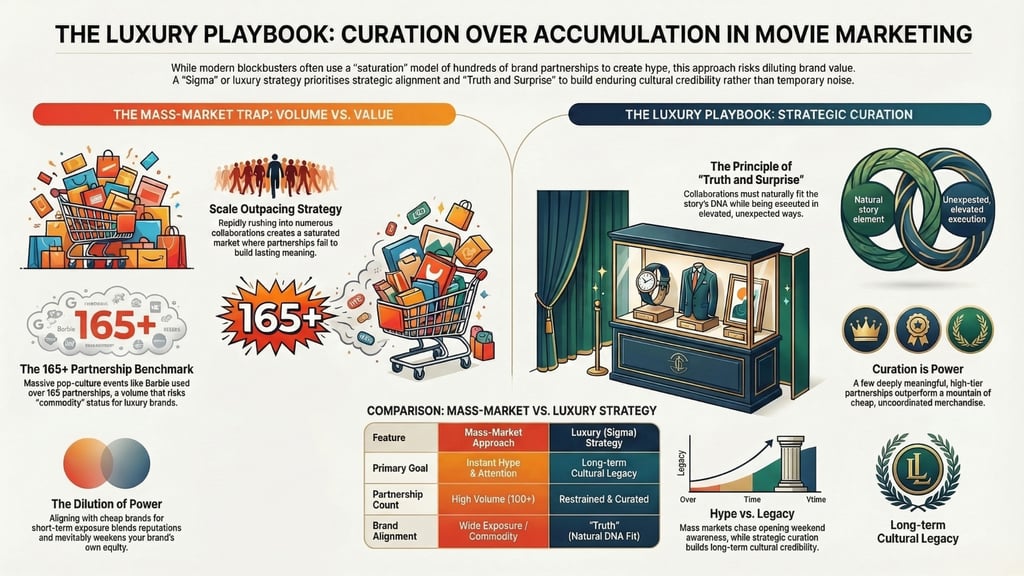
But there is a danger here. As the recent industry research points out, scale has started to outpace strategy. Studios are rushing into collaborations just to create hype, resulting in a saturated market where partnerships grab momentary attention but fail to build lasting meaning. A Sigma strategist knows that when you partner with everyone, you ultimately mean nothing to anyone.
Curation Over Accumulation
Elena: This article is fascinating. It says that Barbie had over 165 different brand partnerships before it even launched. They took over everything from makeup to travel. It was a massive success, but the article also warns that other movies are trying to copy this and failing.
Ayssar: They are failing because they mistake volume for value. Mass-market movies buy attention. Luxury brands build a world.
Elena: But didn’t Barbie build a world by partnering with so many brands?
Ayssar: They did, and it worked for a massive pop culture event. But for a luxury brand, that level of volume is a trap. The article points out a critical flaw: scale has outpaced strategy. When a movie puts its logo on every fast-food cup and cheap t-shirt, it is acting like a commodity. It is screaming for attention.
Elena: That makes sense. It breaks the rule of empty space we talked about before. So, how should a premium film or brand handle collaborations?
Ayssar: Through the principle of Truth and Surprise. A Sigma strategist does not partner with a brand just to get more views. The partnership must be a “truth”, it must naturally fit the DNA of the story. And it must be a “surprise”, executed in a way that feels elevated and unexpected.
Elena: The article mentions the marketing for the new Wuthering Heights movie as a better example of this. They used a much smaller, restrained playbook.
Ayssar: Exactly. They did not try to take over the whole world; they invited a few, highly curated brands to build meaningfully within their specific world. That is the luxury approach.
Elena: So, it is better to have one perfect partnership than fifty average ones?
Ayssar: Always. In the luxury space, a collaboration is an exchange of equity. When you partner with someone, you are blending your reputations. If you align with a cheap brand just to create short-term hype, you dilute your own power.
Elena: The goal isn’t just a spike in awareness for opening weekend.
Ayssar: Precisely. The goal is long-term cultural credibility. The mass market chases the hype of today. The Sigma builds the legacy of tomorrow.
The Danger of the Collaboration Trap
The analysis brings us back to the core of the luxury philosophy: Curation is power. The film industry is currently obsessed with the loud, chaotic strategy of partnering with as many brands as possible. But the highest tier of success is found in restraint. By choosing brand partners that perfectly align with your values and narrative, you transform a simple advertisement into a piece of enduring culture.
Key Takeaway
Strategic alignment creates legacy; thoughtless volume creates noise.
Demand Truth and Surprise: Any collaboration must naturally fit your brand’s DNA while delivering an unexpected, premium experience.
Protect Your Equity: Never partner with a brand just for exposure. A collaboration is a blending of reputations.
Curate Your Universe: You do not need 100 partnerships to be culturally relevant. A few, deeply meaningful collaborations will always outperform a mountain of cheap merchandise.
Luxury does not need to be everywhere. It only needs to be unmistakable where it matters.
Luxury
Expertise in luxury marketing and brand transformation.
Strategy
© 2025. All rights reserved.