
The 2026 Reality Where Luxury Is Access On Your Terms Anywhere
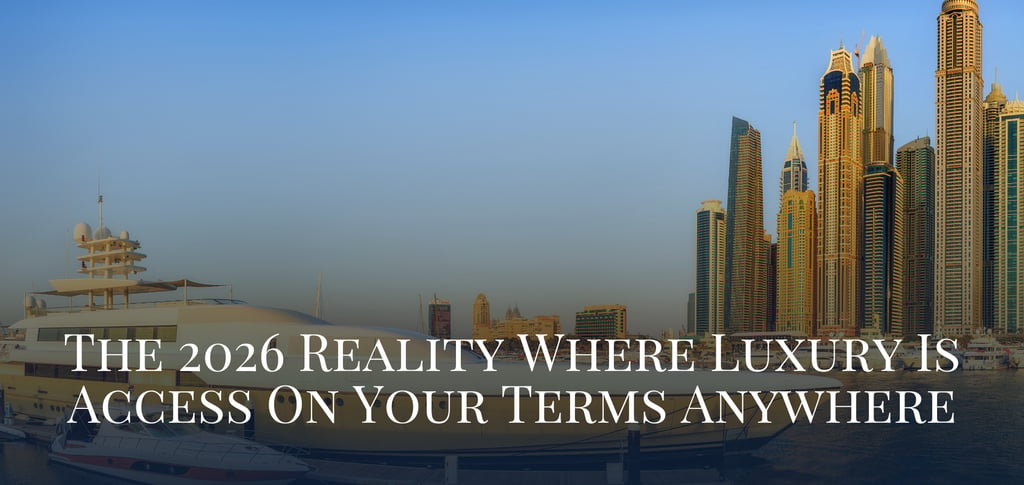

Look at the superyachts anchored in the harbor. On one hand, you have the traditional owner. They possess the deed. But with that deed comes the quiet, relentless friction of maintenance logs, crew payrolls, depreciation, and mooring fees. They own the vessel, but the vessel effectively owns them.
On the other hand, you have the modern Sigma consumer. They step onto an identical yacht, sail for three weeks, and then step off, leaving the liability entirely behind. They possess the exact same view, the exact same sea, and the exact same breeze, but with absolute agility and zero friction.
For decades, the luxury industry operated on a single, rigid commandment: Prestige requires exclusive ownership. If you shared it, or if you rented it, it wasn’t true luxury. It was a compromise.
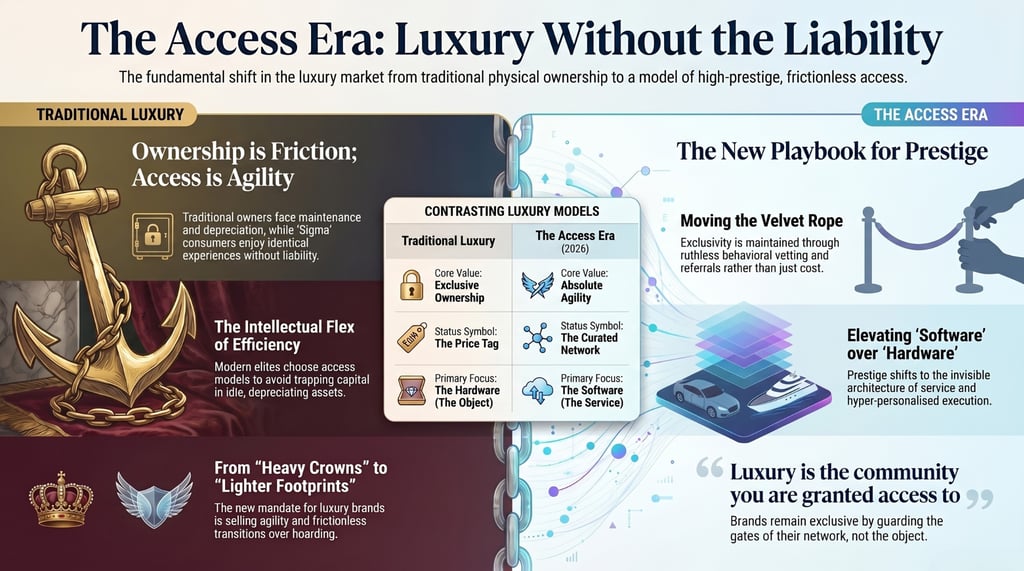
But the market has fundamentally shifted. We have entered the Access Era. From high-end fractional real estate and private aviation syndicates to rotating bespoke wardrobes, shared consumption is no longer a compromise; for the ultra-wealthy, it is a deliberate strategy.
The challenge for luxury brands is profound: How do you maintain the mystique and prestige of a house when the physical product is rented, shared, or fractionally owned?
To survive this era, brands must rewrite their playbook.
How luxury is rebranding for access without losing its soul?!
Moving the Velvet Rope: From Price Tag to Curation
When a luxury asset is available for temporary access, the price barrier is naturally lowered. If a brand relies purely on cost to filter its clientele, access models will destroy its prestige.
The Sigma solution is to move the velvet rope. Prestige in the Access Era is no longer about whether you can afford the daily rate; it is about whether you are invited into the network.
The most successful shared luxury platforms, whether it’s a global residence club or an elite supercar syndicate, operate with ruthless curation. They don’t accept everyone with a credit card. They require interviews, referrals, and behavioral vetting. The luxury is no longer the car or the villa; the luxury is the community you are granted access to. The brand remains highly exclusive, not by hoarding the object, but by guarding the gates.
Elevating the “Software” over the “Hardware”
In traditional luxury, the physical object (the watch, the bag, the vehicle) was the hero. We call this the hardware.
But in an access model, the physical object is simply the baseline. If multiple people are utilizing the same asset, the brand must ensure that every single interaction feels intensely personal. The prestige shifts entirely to the software, the invisible architecture of service.
If a Sigma client utilizes a luxury access model for a week in Saint Moritz, the prestige is not just the chalet itself. It is the fact that the skis are perfectly tuned to their weight and height. When the service is obsessively personalized, the client completely forgets that they do not hold the deed. The frictionless execution becomes the status symbol.
Aligning with the Intellect of Efficiency
The traditional elite bought things to prove they had capital. The modern Sigma mind refuses to trap capital in depreciating, idle assets.
Brands must realize that their highest-tier consumers are choosing access models not out of financial necessity, but out of intellectual efficiency. They hate waste, wasted time, wasted space, and wasted resources.
To maintain prestige, luxury brands must rebrand shared consumption as the ultimate intellectual flex. It is the ultimate statement of unburdened power: “I have the master key to the world’s finest assets, and the absolute freedom to walk away from them when I am done.”
Rebranding
The era of hoarding is coming to a close. The new luxury consumer does not want a heavier crown; they want a lighter footprint.
For brands navigating this transition, the mandate is clear. You cannot sell exclusivity purely through a physical product anymore. You must sell agility. You must sell frictionless transitions. You must sell the quiet, uncompromising standard of your network.
Because in 2026, the ultimate luxury isn’t what you have locked in a vault. It’s what you can access at a moment’s notice, anywhere in the world, completely on your own terms.
Luxury
Expertise in luxury marketing and brand transformation.
Strategy
© 2025. All rights reserved.