Nestlé Japan Strategy That Luxury Watches Are Copying Right Now
How Seeding The Subconscious Today Creates Markets Tomorrow?
5/19/20262 min read
When a heritage luxury brand steps outside its traditional boundaries, the market usually panics.
We saw it when Omega and Blancpain released plastic, mass-market collaborations with Swatch. We saw it when the fiercely independent Audemars Piguet put Marvel superheroes on the dials of $50,000 timepieces, or collaborated with Travis Scott.
To the untrained eye, the critics screaming in the comment sections, this looks like chaos. It looks like brand dilution. They argue that pairing a reputation built on extreme exclusivity and fine horology with mass-market accessibility or pop culture destroys the mystique.
But the Sigma mind observes the world differently. We do not look at surface level reactions; we look at the underlying architecture. What looks like dilution to the crowd is actually a deeply calculated, psychological masterstroke.
Luxury does not think in business quarters. It thinks in generations.
Seeding the Subconscious
To understand this strategy, we have to look outside the watch industry to a legendary piece of psychological marketing: Nestlé in Japan.
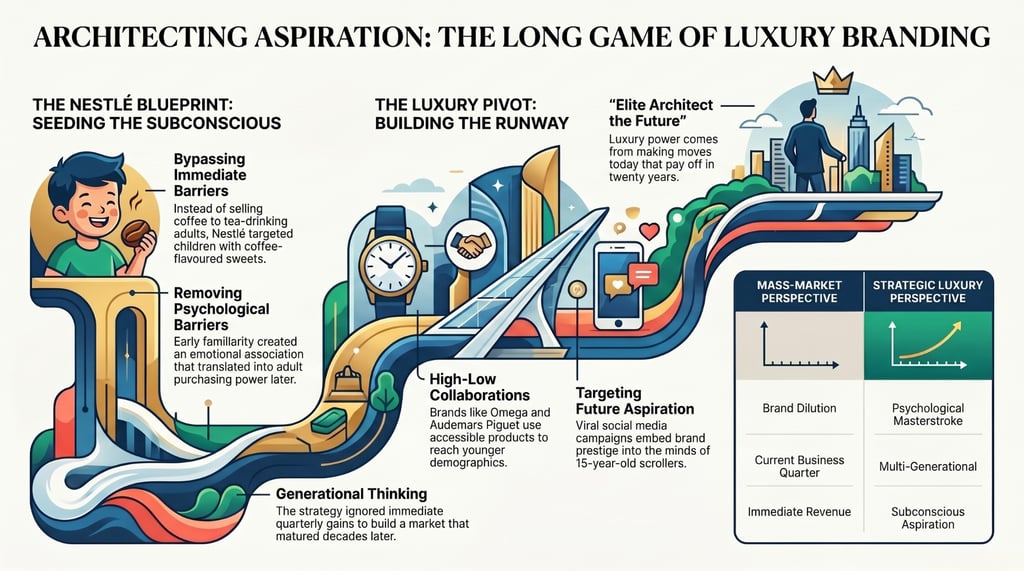
Decades ago, Nestlé wanted to introduce coffee to the Japanese market. The problem? Japan was entirely dominated by tea culture. Coffee consumption among adults was practically non-existent because the emotional and cultural association simply wasn’t there. Selling coffee to adults was a losing battle.
So, Nestlé stopped trying to sell coffee to adults. They targeted the children.
They introduced coffee flavored sweets, candies, and desserts to the younger demographic. They didn’t push the actual beverage; they simply familiarized the youth with the taste and the emotional association of the flavor. By the time those children grew into adults with purchasing power, the psychological barrier was gone. The market already existed in their minds.
Embedding the Aspiration
Luxury watch market is executing the exact same playbook today.
When Omega releases a $260 MoonSwatch, or when Audemars Piguet drops a Spider Man tourbillon that goes viral on social media, they are not primarily targeting their current, established elite clientele. They are targeting the 15 year old scrolling through their phone.
That teenager is not in a position to buy a Royal Oak or a mechanical Speedmaster today. But through cultural relevance, accessibility, and association, the brand is successfully embedding itself into their imagination. They are planting the seed of aspiration.
The critics ask, “Why would a luxury brand lower its standard?” The strategist answers, “They aren’t lowering the standard. They are building the runway.”
Sigma Perspective on Time
The loudest brands in the world operate in a state of constant anxiety, desperate to hit their Q3 revenue targets. They discount, they panic, and they dilute their core offerings just to survive the year.
But power, whether in a billion dollar heritage house or in your own personal career strategy, operates on a much longer horizon. When you possess an uncompromising internal standard, you are not worried about the immediate applause or the short-term critique. You are comfortable making moves today that will not pay off for another ten or twenty years.
You aren’t just selling a product or a service for today. You are embedding your value into the subconscious of the future.
The masses react to the present. The elite architect the future.