In luxury, the price is not what you pay for the product. The price is the product
How Confident Numbers Build The Narrative Of Worth Before The Product Speaks?
Ayssar Al Shihabi
7/13/20264 min read
Eradication of Friction (Partitioned Pricing)
Consider the business model of a budget airline. You pay a low base fare, but then you are charged for your carry-on, charged to pick a seat, and charged for a bottle of water. This is Partitioned Pricing. It is the architecture of annoyance.
Nothing destroys the luxury illusion faster than being nickeled and dimed.
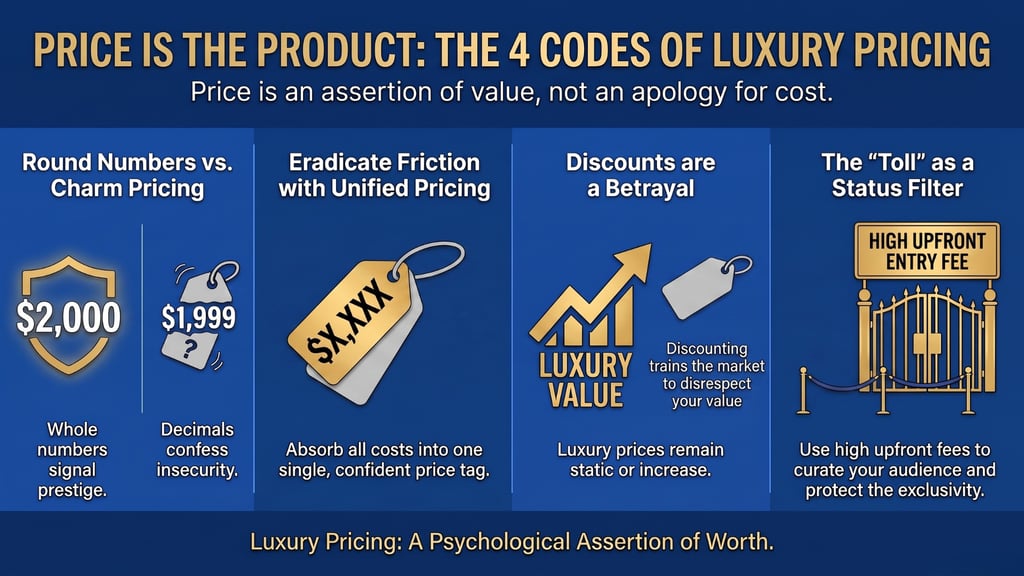
When a client operates at the highest level, their most valuable asset is their mental bandwidth. They want a frictionless sanctuary. If you sell a $15,000 piece of fine art and then send an invoice adding $150 for shipping and $40 for insurance, you look incredibly petty. You have shattered the illusion of abundance for pennies.
Luxury offers a single, unified number. The delivery, the bespoke packaging, the white glove installation, it is all seamlessly absorbed into one confident price tag. You do not sell line items; you sell absolute peace of mind.
Betrayal (Why Luxury Never Skims)
In the tech industry, brands often use a strategy called “Skimming.” They release a new smartphone for $1,200, capture the early adopters, and then slowly drop the price to $800 over the next year to capture the rest of the market.
If a luxury brand does this, it signs its own death warrant.
When you discount a luxury asset, you commit the ultimate betrayal against your most loyal clients. You tell the person who believed in you enough to pay full price on day one that they were foolish. Furthermore, you train the rest of the market to never respect your initial price, because they know if they just wait, you will eventually fold.
In the luxury mindset, prices remain static or they increase. They never go backward. A brand that holds its price, even during an economic downturn, proves that its standard is unshakeable.
Psychology of the Toll (Two-Part Tariff)
How do you create an ecosystem so desirable that people will fight just for the privilege of entering? You build a massive, upfront psychological moat.
This is the Two-Part Tariff, often used by elite private clubs or the legendary Amex Centurion “Black Card” (which famously requires a massive initiation fee simply to open the account, followed by a heavy annual fee).
To the mass market, paying $10,000 just for the “right” to pay a $5,000 annual fee sounds insane. But to the Sigma mind, this is brilliant architecture. The massive entry fee acts as a status filter. It ensures that the room is curated. People inherently protect and value what they had to bleed slightly to access. You are not just selling a service; you are selling the exclusivity of the velvet rope itself.
-----
Mass market pricing is essentially an apology. It is a brand begging the consumer to choose them by offering the path of least financial resistance.
Luxury pricing is an assertion. It is the brand stating exactly what it is worth and waiting for the right minds to rise to the occasion.
When you set your price, you are not just managing your revenue. You are writing the narrative of your own worth. Make sure you are speaking the right language.
Walk into any mass market retail store, and you will hear a very specific, very loud psychological language. The shelves are screaming with bright red tags, slashed numbers, and limited time offers. The entire environment is engineered to convince you that you are getting a bargain, that you are somehow outsmarting the system.
But if you possess a Sigma mindset, you find this environment exhausting. It feels desperate.
When you step out of the mass market and enter the silent, unbothered sanctum of luxury, the language completely changes. In this ecosystem, price is not calculated by simply taking the cost of production and adding a modest margin. In luxury, the price is not what you pay for the product. The price is the product.
It is a signal. It is an anchor. It is the invisible architecture that dictates exactly how the brand views itself, and how it expects you to view it.
If you are building a premium brand, a high-end consultancy, or an elite personal network, the numbers you choose to present to the world dictate your reality.
This is the unwritten psychological code of luxury pricing, and how to use it to establish absolute authority:
Confession of $1,999 (Charm Pricing)
In the mass market, pricing a product at $1,999 instead of $2,000 is considered a masterstroke. It tricks the human brain into feeling like it is spending one thousand something rather than two thousand.
But in the luxury sector, Charm Pricing is a fatal error.
To the highly analytical mind, a price ending in .99 is a confession of insecurity. It tells the client: “We know this is expensive, so we are playing a psychological trick to soften the blow. We have dropped our standard to the absolute lowest tolerable figure just to get you to buy.”
Luxury operates on Prestige Pricing. Clean, absolute, whole numbers. $2,000. $50,000. It does not apologize for itself. A whole number signals unshakeable confidence. It establishes a firm boundary, telling the client that the value is intrinsic and the brand refuses to play games.