How Seven Jewelry Houses Engineered Legacies Instead Of Just Polishing Rocks
Mastering Perception Matters More Than Mastering Materials In High Jewelry
Ayssar Al Shihabi
7/6/20263 min read

When the average consumer looks at high jewelry, they see a price tag. They see a glittering accessory designed to catch the eye of a stranger.
But when you observe the world through the uncompromising, analytical lens of the Sigma mindset, you realize that high jewelry is never just about the stones. It is about power, leverage, and the engineering of a legacy. The world’s most prestigious jewelry houses did not build their empires by simply polishing rocks. They built them by mastering human psychology, inventing new standards, and refusing to bend to the trends of the masses.
If you study the historical milestones of the seven defining houses of global high jewelry, you are not just studying fashion. You are studying the ultimate playbook on how to build an untouchable brand.
How they did it?
Van Cleef & Arpels and Harry Winston
The ultimate flex of a Sigma professional is making agonizing, obsessive labor look entirely effortless. You do not show the crowd your sweat; you only show them the result.
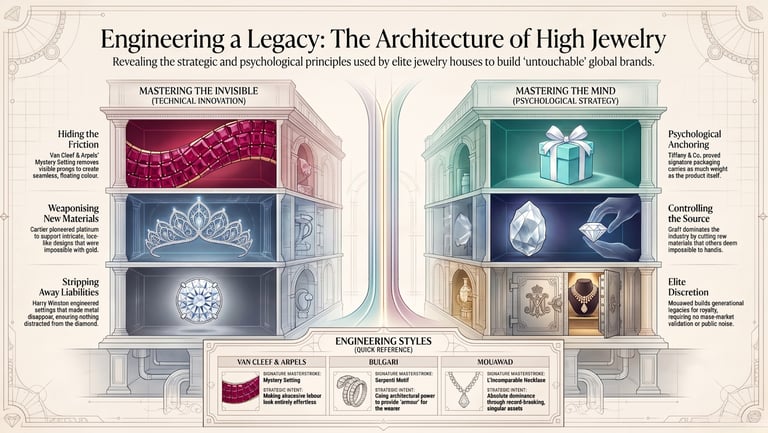
Van Cleef & Arpels materialized this philosophy in 1906. While other jewelers relied on heavy, visible prongs to hold their stones, Van Cleef invented the Mystery Setting. They engineered a technique so precise that the metal infrastructure completely vanished, leaving only a seamless, floating expanse of color. They hid the mechanics to elevate the illusion.
Decades later, in 1932 New York, Harry Winston applied a similar uncompromising focus to diamonds. Dubbed the “Diamond Whisperer,” Winston engineered settings, like his famous Winston Cluster, where the metal practically disappeared. He understood that when you possess an asset of absolute, intrinsic value (a flawless diamond), anything that distracts from it is a liability. You strip away the unnecessary so the core asset speaks for itself.
Cartier and Bulgari
Luxury does not ask for permission. It breaks the established rules of its era and forces the market to adjust.
Cartier earned the title “Jeweler of Royals” not by playing it safe, but by dominating the materials. They were the first to weaponize platinum, allowing for intricate, lace-like designs that gold could never support. But their Sigma energy is found in their motifs: The Panthère, a symbol of sleek, fearless independence, and the Tutti Frutti collection. At a time when traditional rules dictated strict, monochrome elegance, Cartier carved wild, tropical stones together. They broke the rules with such absolute authority that their rebellion became the new standard.
Meanwhile, Bulgari conquered Rome and Hollywood by blending ancient Greek and Roman architecture with aggressive, seductive charm. Their iconic Serpenti motif, sinuous, coiled snakes, is the ultimate symbol of transformation and quiet power. They didn’t just dress Elizabeth Taylor and Audrey Hepburn; they provided the armor for women who dominated their respective eras.
Tiffany & Co. and Graff
You cannot maintain a luxury empire by reacting to the market. You must dictate the limits of what is possible.
Tiffany & Co. understood the power of the psychological anchor. They didn’t just invent the Tiffany Setting, lifting a solitary diamond on six prongs to maximize its brilliance, they essentially invented the modern engagement ring. But their greatest masterstroke was claiming a color. The signature little blue box proves that when your brand identity is strong enough, the packaging carries as much psychological weight as the product itself.
In London, Graff built an empire on the audacity of raw creation. Laurence Graff didn’t just buy finished stones; he controlled the source, cutting colossal rough diamonds that others deemed impossible, like the 1,109-carat Lesedi La Rona. Graff operates at the absolute ceiling of the market, proving that whoever controls the rawest, rarest materials controls the industry.
Quiet Legacy of Kings: Mouawad
Perhaps the most fascinating house to the Sigma mind is the one that operates with the most discretion.
Founded in Beirut in 1891, Mouawad did not build its empire by chasing mass-market retail or loud red carpets. They quietly became the jeweler of choice for Middle Eastern royalty. They do not sell seasonal fashion; they commission generational legacies.
This is the house that created the L’Incomparable, confirmed by Guinness as the world’s most valuable necklace at $55 million, centering around a massive 407.48-carat flawless yellow diamond. Mouawad represents the ultimate state of luxury: absolute, unbothered dominance that requires no mass validation.
The Standard
The lesson from these seven houses is absolute. Whether you are building a business, a personal brand, or a private portfolio, you cannot rely on surface level shine. You must engineer your value from the inside out.
Invent the standard, hide the friction, and never compromise the core asset. That is how you turn a product into a legacy.