How Pierre Cartier Bought A Fifth Avenue Mansion For $100 And A Necklace?
Cartier Used Someone Else's Want To Secure Everything They Needed
Ayssar Al Shihabi
6/10/20263 min read
When the average consumer sees the iconic red Cartier box, they see a piece of jewelry. They see a status symbol, an expense, or perhaps a romantic gesture.
But when you observe the world through the Sigma lens, a mindset that looks past the sparkling surface to study the deep, underlying mechanics of power and value, you see something entirely different. You see a meticulously engineered empire.
A recent breakdown of Cartier’s history perfectly illustrates this reality. The sustained elitism of Cartier is not a lucky accident of good design. It is the result of a century long, multi-generational masterclass in strategic alliances, asymmetrical negotiation, and absolute control over narrative.
For the modern strategist, the story of Cartier is not a story about diamonds. It is a playbook on how to build an untouchable legacy. Here is how five key architects engineered eternity.
1. Apex Strategy
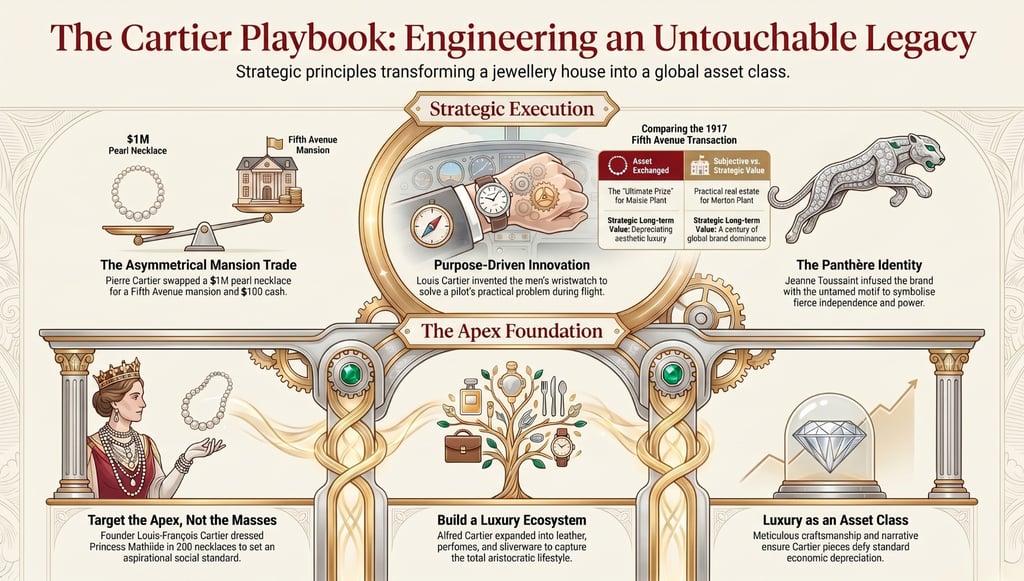
The foundation of the empire was laid by Louis François Cartier in 1847, operating under a brutally simple, uncompromising standard: “Never imitate, always innovate.” But innovation without visibility is useless. Louis François understood that to capture the luxury market, you do not market to the masses; you market to the apex. In an early, masterful form of influencer strategy, he dressed Princess Mathilde of Paris in 200 of his necklaces. He didn’t chase the crowd. He placed his work on the highest possible rung of the social ladder, knowing the crowd would naturally look up and chase the standard he set.
This was compounded by his successor, Alfred Cartier, who took over in 1874. Alfred understood that true wealth requires an ecosystem. He expanded the brand from pure jewelry into a broader luxury lifestyle, leather goods, silverware, perfumes, while using strategic marriages to secure untouchable access to aristocratic wealth.
2. Negotiation of the Century
If there is one story in the Cartier archives that perfectly embodies the Sigma mindset, it is the masterstroke of Pierre Cartier, the global expansionist.
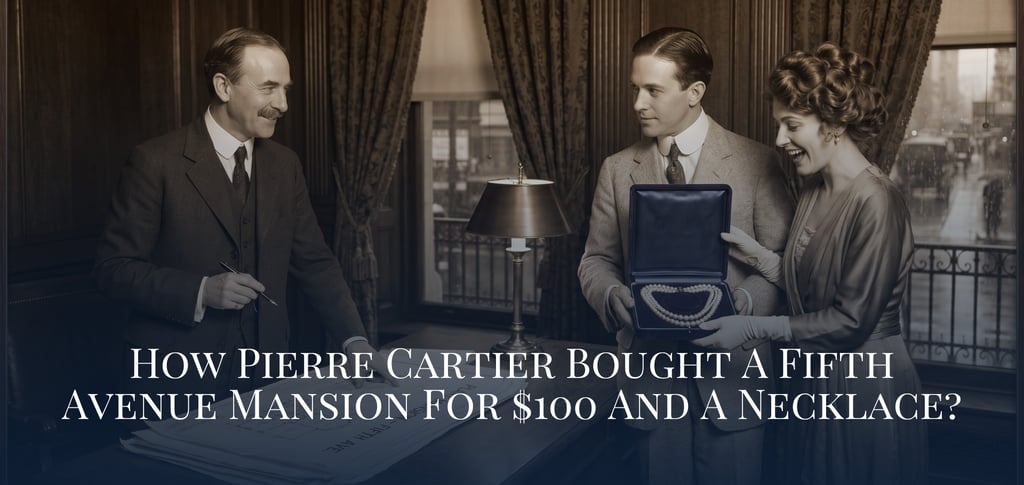
In 1917, Pierre wanted to secure a flagship location in the heart of New York City. He found a magnificent Renaissance style mansion on 5th Avenue owned by millionaire Morton Plant. Plant’s young wife, Maisie, had fallen completely in love with a flawless, double strand Cartier pearl necklace valued at $1 million.
Pierre executed a flawless asymmetrical trade. He acquired the 5th Avenue mansion in exchange for just $100 in cash and that exact pearl necklace.
He understood the subjective nature of value. To the Plants, the pearls were the ultimate prize. To Pierre, the pearls were a tool to secure a piece of generational real estate that would anchor the brand’s global dominance for the next century. It was pure, unbothered leverage.
3. Purpose-Driven Design and the Power of Identity
At the creative helm were Louis Cartier and his muse, Jeanne Toussaint. They understood that luxury must solve a problem or embody a fierce identity.
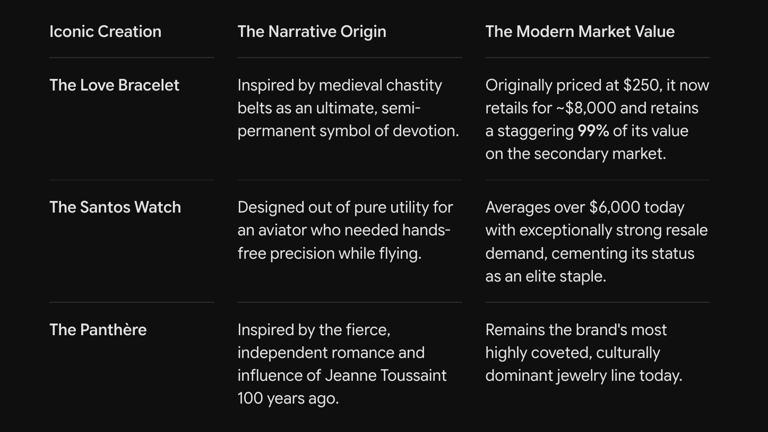
Louis Cartier didn’t just design pretty things; he designed with elite functionality in mind. In 1904, his friend, the pioneer aviator Alberto Santos Dumont, complained that pulling out a pocket watch while flying was impractical. In response, Louis created the Santos, the first ever men’s wristwatch. It was a functional tool for an elite operator that evolved into a global status symbol.
Simultaneously, Jeanne Toussaint took over the design direction and infused the brand with its most recognizable, untamed motif: The Panthère. Toussaint was fiercely independent and unapologetic, a true Sigma archetype. She infused her own unbothered identity into the metal, creating a symbol of power that remains highly coveted a century later.
Asset Class of Luxury
The proof of Cartier’s strategic dominance is not how much their pieces cost, but how much value they retain. Luxury is an asset class. Because Cartier engineered their brand upon heritage, craftsmanship, and narrative, their modern creations defy standard economic depreciation.
Takeaway
Anyone can buy expensive materials and attempt to sell them at a markup. But creating a brand that commands absolute global respect for over 170 years requires a different level of psychological mastery.
Cartier teaches us that sustained elitism is deliberately engineered. It is the result of refusing to imitate, mastering the art of the strategic trade, and infusing your work with a narrative so powerful that the world has no choice but to respect it.
Luxury isn’t just what you wear. It is how you play the game.