Five Critical Sins That Get You Quietly Banned From Elite Spaces Forever
How One Wrong Move Gets You Blacklisted From Every Boutique Globally!
Ayssar Al Shihabi
6/5/20263 min read

When you spend an afternoon quietly observing the choreography inside an ultra-luxury boutique, you will witness a fascinating psychological study.
You will see individuals walk through the door draped in visible designer labels, radiating an air of loud entitlement. They assume that a heavy bank account or a high limit credit card grants them absolute dominance over the space. They treat the atelier like a standard retail store, unaware that every movement, word, and interaction is being subtly evaluated.
In the world of mass-market retail, if you have the money, you get the product. But in the elite echelons of luxury, the rules completely change. Brands like Chanel, Hermès, or Ferrari operate on a strict, invisible code of conduct. They maintain exclusive VIP lists and possess the absolute authority to quietly “blacklist” shoppers who violate their unwritten etiquette.
As an observer of human behavior and market dynamics, I find that the reasons people get banned from these spaces reveal a profound truth about human psychology. Luxury is not a commodity you buy; it is an ecosystem of trust you enter.
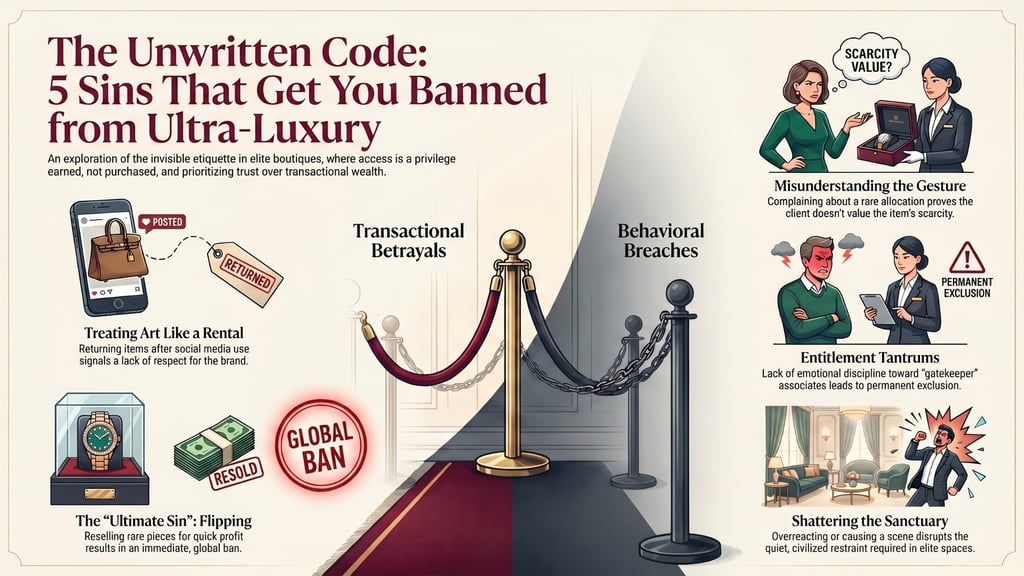
According to insights shared by luxury market experts, there are five critical sins that will quietly get you excluded from the world’s finest boutiques. When analyzed through a lens of self-restraint and intrinsic value, it becomes clear why these behaviors are fundamentally incompatible with the luxury mindset.
Treating Art Like a Rental (Serial Returner)
There is a segment of consumers who view luxury boutiques merely as a backdrop for their social media feeds or an event armor. They purchase an elite outfit, wear it to a high profile gathering or an Instagram shoot, and then promptly return it to the store.
This behavior is a massive red flag for heritage brands. Beyond disrupting inventory, it signals a profound lack of seriousness and an obsession with external validation, buying an illusion to impress a crowd. Luxury demands commitment. When you transact at this level, you invest in pieces you intend to keep, respect, and permanently weave into your personal narrative.
Trading Mystique for Quick Profit (Flipper)
The video labels this as the “biggest sin ever,” and the industry treats it with zero tolerance. When a client manages to secure a highly exclusive, sought after piece and immediately lists it online to flip it for a profit, the relationship with the brand is instantly severed.
Luxury houses employ sophisticated tracking systems, monitoring serial numbers and online reselling platforms to identify opportunists. Flipping betrays the ultimate law of the luxury code: it reduces an object of rare craftsmanship down to a cheap, transactional hustle. If you are tagged as a reseller, the ban is rarely local; it is global.
Misunderstanding the Gesture (Complainer)
Because luxury operates on extreme scarcity and severely limited supply, the allocation of a rare piece is never accidental. If a sales associate goes into the back vault and offers you a highly coveted item, it is not a sales pitch. It is an intentional signal of deep trust.
Amateurs often misunderstand this dynamic, openly complaining that the color isn’t perfect, the size is slightly off, or the design isn’t exactly what they envisioned. While a polite acceptance or a graceful decline is entirely respected, vocal dissatisfaction is viewed as a breach of etiquette. It demonstrates that the consumer does not understand the rarity of what they were holding, ensuring they are never offered an exclusive piece again.
Entitlement Tantrum (Bad Attitude)
The quickest way to be permanently escorted out of a luxury ecosystem is to lack emotional discipline. When an item is out of stock, or when access is restricted, the insecure consumer often resorts to throwing a tantrum or weaponizing an attitude of entitlement.
What these individuals fail to realize is where the true power dynamics lie. The sales associates are not servants; they are the gatekeepers. They hold the keys to the most coveted vaults and determine who gets access to the brand’s soul. In these spaces, patience, respect, and a calm disposition are mandatory entry requirements. If you cannot master yourself, you will not be permitted to master the brand.
Shattering the Sanctuary (Overreactor)
It is entirely natural to feel a sense of profound satisfaction when you finally secure a dream piece you have pursued for years. However, luxury environments are designed as sanctuaries of quiet, civilized restraint.
Walking into an atelier and screaming, overreacting, or causing a scene completely disrupts the reserved atmosphere required by other discerning clients. Luxury values absolute discretion. The ultimate flex is not letting the entire room know what you just acquired; it is the quiet confidence of closing the box, thanking the associate, and walking out into the world in silence.
The Final Lesson
The ultimate takeaway from the architecture of high-end shopping is simple: access cannot be demanded; it must be earned.
Gaining entry to the highest tiers of luxury isn’t a financial game. It is a relationship game rooted in mutual respect, unshakeable trust, and quiet class. The brands are not just evaluating your net worth, they are evaluating your character.
Before you step across the threshold of an elite boutique, remember that the most valuable asset you can bring into the room is your own internal standard of dignity.