Cartier Preserves Historical Techniques While Competitors Outsource Their Mastery
How Cartier Turned Preservation Into The Most Powerful Marketing Strategy?
Ayssar Al Shihabi
5/31/20263 min read


If you sit quietly and observe the global financial reports of the world’s largest fashion conglomerates right now, you will hear a rising panic. Sales are cooling. Aspirational buyers are pulling back. Industry analysts are desperately writing headlines about a “luxury crisis.”
But if you view the market through a Sigma lens, an independent, highly analytical mindset that sees past marketing smoke and mirrors, you realize something fundamentally different.
There is no crisis in luxury. The crisis is entirely contained within a broken, modern illusion: the hybrid model.
For the past decade, countless brands have tried to serve two masters. They attempted to reconcile stratospheric, mass-market profit margins with the illusion of elite exclusivity. They scaled their production, slapped massive logos on generic products, and raised their prices to astronomical levels to manufacture prestige.
But the discerning consumer has woken up. And they are refusing to play the game.
Why the hybrid model is collapsing, and why the brands that maintain rigorous, uncompromising control are the only ones left standing?
Trap of the Hybrid Model
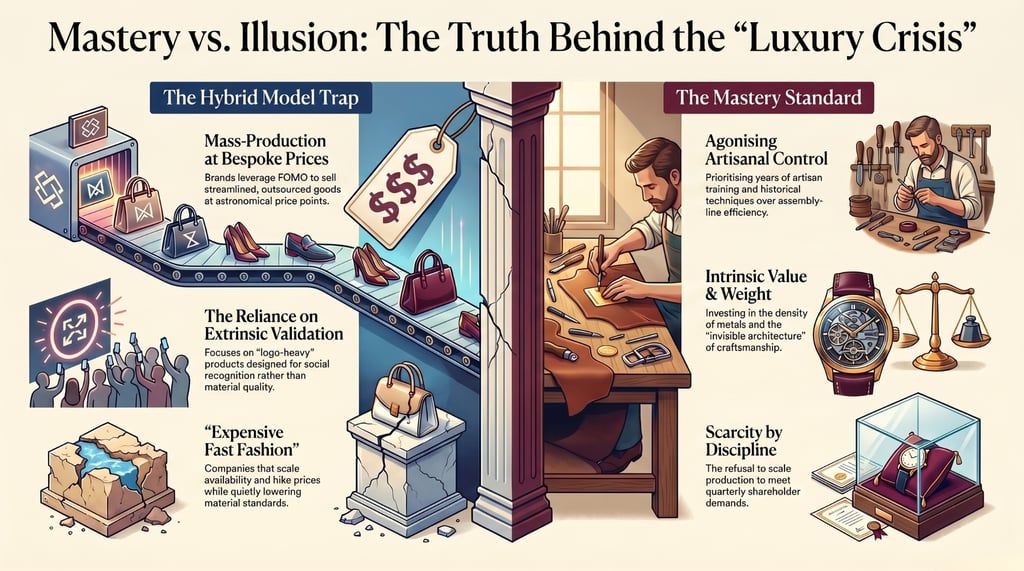
The hybrid model is built on a very fragile psychological trick: selling mass-produced goods at bespoke prices by leveraging FOMO (Fear Of Missing Out).
These brands rely on extrinsic validation. They want the consumer to buy a heavily branded bag or sneaker simply so strangers on the street will recognize how much they spent. To maximize margins, production is quietly streamlined, outsourced, or mechanized, while the marketing budget explodes.
For the Sigma consumer, this is the ultimate turn off. We do not seek the applause of the crowd, and we are fiercely allergic to being manipulated. When a brand scales its availability while simultaneously hiking its prices and lowering its material quality, it is no longer a luxury house. It is simply a very expensive fast fashion corporation.
True Exclusivity
Contrast this with heritage houses like Hermès and Cartier, which continue to perform exceptionally well despite global economic headwinds.
Why? Because they refuse to adopt the hybrid model. They understand that luxury cannot be mass-produced, and they maintain rigorous, agonizing control over their production.
Hermès does not build automated factories to pump out more Birkins to meet quarterly shareholder demands. They train artisans for years. If a bag takes dozens of hours of hand stitching by a single master craftsperson, that is how long it takes.
Cartier preserves historical, artisanal techniques in fine jewelry and horology, ensuring that the piece you hold is a triumph of human mastery, not a triumph of assembly line efficiency.
They offer a value that goes infinitely deeper than the superficiality of a logo. They offer intrinsic weight.
Shift in the Luxury Mindset
We are witnessing a massive correction in the high-end market. The era of buying a logo just to prove you have capital is ending.
The consumers who actually drive the highest tiers of the market, those operating with a quiet, secure, Sigma mindset, are demanding actual value again. When they invest their capital, they want to feel the density of the metal, the meticulous perfection of the leather, and the invisible architecture of the craftsmanship. They are buying the story, the scarcity, and the standard.
If a brand’s only value proposition is the fact that its name is printed in bold letters across the chest, it is doomed to fail the moment the cultural hype shifts.
The Ultimate Standard
You cannot hack luxury. You cannot scale a masterpiece to meet a quarterly revenue target without destroying its soul in the process.
The brands that will survive the next decade are the ones that possess the discipline to say no. No to mass expansion. No to compromised materials. No to the loud, empty noise of trend chasing.
Because ultimately, luxury isn’t about proving how much money you can extract from the masses. It is about maintaining a standard so high that the masses simply cannot reach it.